
Analysis: UK sales of electric vehicles just overtook petrol cars for the first time


Multiple Authors
06.25.26Multiple Authors
25.06.2026 | 11:15amFor the first time in the UK, more new electric vehicles (EVs) have been sold over a 12-month period than petrol cars, according to Carbon Brief analysis.
The news comes amid a battle over the future of the UK’s “zero-emissions vehicle” (ZEV) mandate, which the car industry and some unions are pushing to water down.
The mandate sets a rising target for the share of new car sales that must be “zero-emissions vehicles” (ZEVs) each year – primarily “pure” or “battery” EVs that only run on electricity.
The car industry argues that demand for these cars is too low to meet the requirements of the ZEV mandate, despite the fact that the industry has “over-complied” to date.
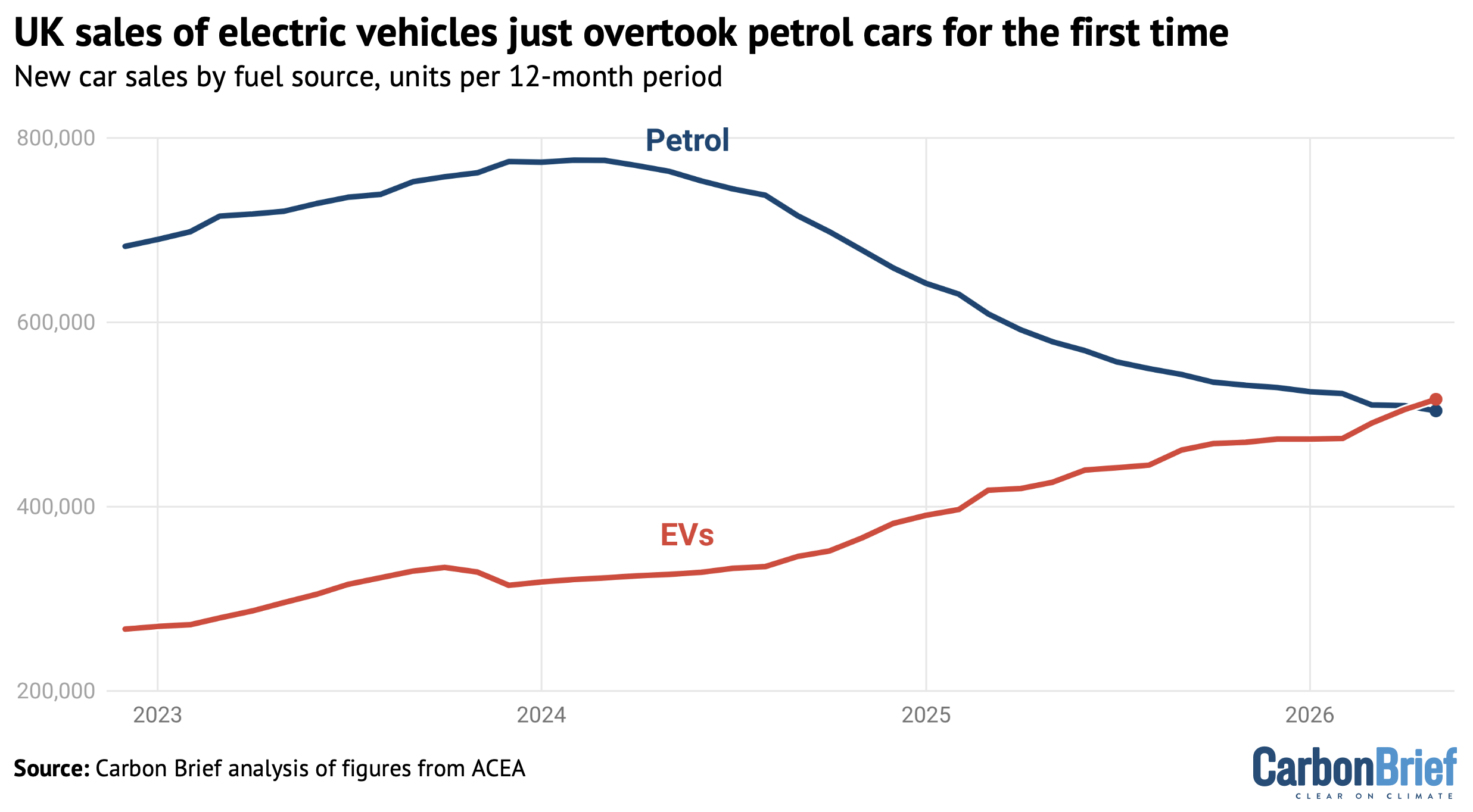
Carbon Brief’s analysis of the latest data on new UK car sales, shown in the figure below, illustrates that demand for EVs has, in fact, grown consistently – and it has now overtaken demand for petrol cars for the first time.
In the 12 months to May 2026, UK consumers bought 516,490 new BEVs, against only 504,010 new petrol cars.
Note that the analysis is based on figures from the European Automobile Manufacturers’ Association (ACEA). Figures published by the UK Society of Motor Manufacturers and Traders (SMMT) are based on a slightly different categorisation for hybrid cars.
All hybrids run entirely on petrol or diesel fuel, while also carrying a small battery and an electric motor. ACEA counts these cars separately to petrol and diesel models.
In contrast, the SMMT counts what it calls “mild” hybrids as petrol cars, while listing “full” hybrids – such as Toyota’s Prius – in a separate category.
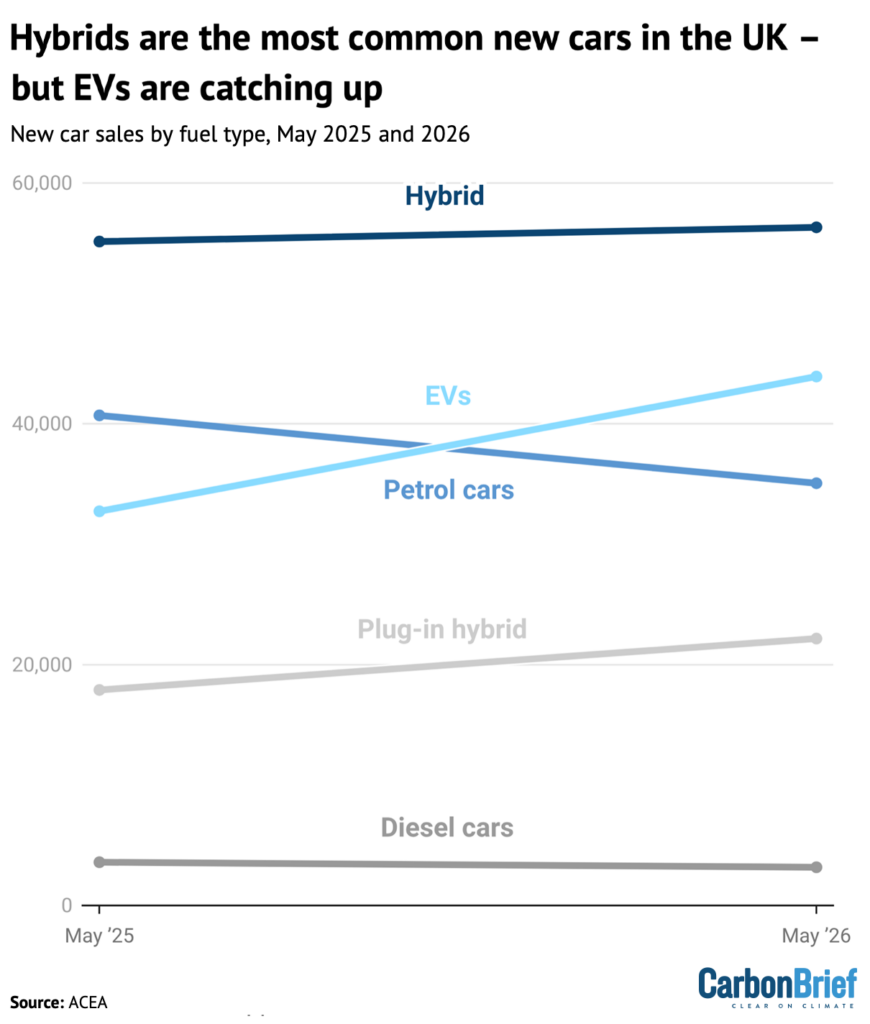
The ACEA data shows that hybrids are the most popular type of car in the UK, as illustrated in the figure below, but also shows that their sales are relatively stagnant.
Some 56,321 hybrids were sold in May 2026, the most recent month with data from ACEA. This is an increase of 1,181 year-on-year, or just 2%.
In contrast, EV sales grew 34% to reach 43,931, while petrol cars were down 14% to 35,068.
Plug-in hybrids, which can be run on electricity from the grid or from a petrol engine, are also seeing relatively rapid sales growth, up 24% year-on-year in May 2026 to 22,167.
(In the UK, numberplates for “pure” EVs that only run on electricity are marked out by a distinctive green stripe on the left-hand side. These stripes are not used for any type of hybrid.)
The new analysis for the UK follows a similar milestone for the EU, with more BEVs having been sold in the month of December 2025 than petrol cars.
The UK first saw more sales of BEVs than petrol cars in a single month in December 2022, but this pattern has only been repeated on a consistent basis over the past year.
Globally, EV sales grew by 20% in 2025 and accounted for one in every four new cars sold, according to the International Energy Agency (IEA).
The agency said that global EV sales were set to grow by another 15% in 2026.